Roof replacement in Ashford costs £4,800-£7,500 for a 3-bed semi in concrete tile, or £6,500-£10,000 in clay. Every re-roof uses breathable membrane and carries a written, transferable 10-year workmanship guarantee. We survey before quoting and advise honestly on repair versus replacement. Call 01233 877 146.
The 1960s concrete tile stock on Bockhanger and Stanhope estates is now at end of design life. Full re-roofs with modern clay or quality concrete tile, proper batten replacement and correct ventilation. Free survey and itemised quote: 01233 877 146.
A re-roof is the right call when failure is systemic rather than localised. On Ashford's 1960s-70s estates the tell is nail sickness spreading across whole slopes at once.
When it is not the answer: A sound roof with one failed valley or a handful of slipped tiles does not need replacing - and any roofer pushing a full re-roof for a localised fault is not acting in your interest. Read the full guide.
Ashford's two primary re-roofing populations require completely different approaches. On the Bockhanger and Stanhope estates, the dominant product is concrete interlocking tile from the 1960s, now 55-60 years old. The combination of corroded nails, degraded felt underlays and worn tile surfaces means a tile-only swap no longer makes economic sense — the whole system needs replacing. We specify modern concrete or clay interlocking tiles, replace all battens and underlay, and install correct ridge ventilation.
Victorian terraces in Newtown and the conservation-sensitive Church Road area require clay plain tiles or matched Welsh slate. We source to planning specification and advise on any permitted development constraints before quoting.
3-bed semi (concrete tile): £4,500-£7,000. 3-bed semi (clay tile, conservation): £6,000-£9,000. 4-bed detached: £8,000-£13,000. All prices include scaffold, strip and disposal, full batten and underlay replacement, new tiles and ridge. Subject to free survey.
📞 01233 877 146
Mon–Fri 8am–6pm · Sat 8am–2pm
We assess the covering, battens and underlay from inside and out, and confirm whether replacement genuinely beats continued repair.
Scaffold, strip and disposal, membrane, battens, tiles, ridge and lead each as a separate line, with a stated batten-replacement allowance so there are no mid-job surprises.
We agree a start date and give a realistic day-count; scaffold goes up first, arranged and licensed by us.
We strip the old covering, replace defective battens, lay breathable membrane and re-cover with new tiles and stainless fixings.
Full clearance and magnet-sweep, a walk of the finished roof, and a written transferable 10-year guarantee.
| Job | Typical duration |
|---|---|
| Terraced house re-roof | 3-5 days |
| 3-bed semi re-roof (typical Ashford estate) | 5-8 days |
| Detached / complex roof | 1-2 weeks |
| Weather delay | Adds days in a wet spell - built into the plan |
Re-roofing pauses in heavy rain or high wind; the Stour valley's damp makes a planned dry-season replacement smoother than an emergency winter one.
A re-roof always needs full scaffold for safe working and to protect the public below. Scaffold is specified for: the full duration of any re-roof - it is standard and itemised, never an add-on - always itemised in your written quote, never a hidden extra, and we arrange it.
Ashford's Victorian terraces around Newtown and Church Road often have rear access only, so scaffold and skip placement need planning; the post-war estates at Bockhanger and Stanhope have driveways that usually take a skip without a permit. Pavement scaffold and skip permits go through Ashford Borough Council; allow a few working days on streets like the terraces around Newtown, Bank Street, the older lanes off Beaver Road where space is tight.
"Full re-roof on our 1960s Stanhope semi. They surveyed it properly, explained why the tiles couldn't just be re-nailed and gave us a clear quote. The job was done in five days including scaffold. Very impressed."
"Victorian terrace in the Newtown conservation area — needed matching clay plain tiles. They sourced the right profile and re-roofed the front pitch to match exactly. Excellent specialist work."
"4-bed detached in Kennington. Complete strip and re-tile with modern clay. Clean and professional from start to finish, tidy site every day. The 10-year guarantee gave us real peace of mind."
The decision between repair and replacement is the most important conversation we have at the survey stage. Replacement is justified when the cost of repeated repairs approaches the cost of a new roof within a 5–10 year window, or when the roof has reached systemic failure — nail sickness across the majority of the slope, perished underlay, multiple failed flashings. Repair is appropriate for isolated failures on a roof that is otherwise structurally sound.
On Ashford's 1960s and 1970s concrete tile estate housing — Bockhanger, Stanhope, Park Farm, Singleton — the decision is often clear. Properties in this cohort that have not had significant roofing work are typically presenting with nail sickness across most of the main slope, failed or absent underlay, and multiple tile fractures. Patching these roofs extends their functional life by 2–5 years at most before the next problem emerges. Full replacement addresses the system as a whole and provides 40–60 years of service from the new installation.
We will always tell you honestly if repair is the right answer. We do not recommend re-roofing work that is not justified by the condition of the roof.
Every re-roof quote is preceded by a full survey. We inspect the existing tile condition and nail sickness extent from ground level and safe access. We check the underlay condition from inside the loft — perished underlay is often visible as daylight penetration or as dark staining on the sarking. We check the batten condition and rafter ends. We assess chimney stacks, flashings, valleys, verges and ridge details. We note any areas of the roof structure that require attention before the new covering can be installed. All of this is included in the written survey and quote.
Day 1: Scaffold erected (subcontracted to our regular scaffold team, included in our quote). Existing tiles stripped and loaded into skip. Underlay and battens inspected. Any structural timber replacement carried out. Day 2–3: New breathable underlay installed over the entire slope. New battens laid to correct gauge for the tile specified. Tiles laid from eaves to ridge. Ridge tiles bedded in mortar or fitted with dry-fix system. Flashings formed in lead where required. Day 4: Ridge pointing completed. Scaffold adapted or struck. Site cleaned. Final inspection with the homeowner. Days given are indicative for a standard 3-bed semi — larger properties take longer.
A replacement roof is a system, not just a tile covering. Every component plays a role in the finished installation's durability and performance. Understanding what each element does helps homeowners make informed decisions when comparing quotes.
Underlay is the secondary waterproofing layer beneath the tiles. All our re-roofs use breathable underlay as standard. Breathable membrane allows water vapour to migrate out of the roof void while blocking liquid water penetration from outside. This prevents the moisture accumulation and condensation that causes batten rot and rafter degradation in roofs with traditional impermeable felt.
For most post-war estate housing: concrete interlocking tile like-for-like. For 1930s semis: either concrete interlocking or modern clay interlocking (better lifespan, modest additional cost). For Victorian and Edwardian properties: clay plain tile on visible slopes, or Welsh slate where slate was original. For conservation area properties: reclaimed or reproduction clay plain tile. We advise on the correct specification for each property at the survey.
All valley linings, chimney flashings and parapet details are formed in lead. We specify Code 4 lead as standard, Code 5 on exposed coastal elevations or where additional service life is valued. Lead is the correct material for all complex junctions — it is flexible enough to accommodate thermal movement, long-lived (25–40 years for Code 4, longer for Code 5), and well-established as the benchmark performance standard in UK roofing.
All re-roofing work carries our written 10-year workmanship guarantee. The guarantee covers the installation — tile laying, ridge work, lead details, flashings. Materials are warranted separately by the manufacturer. The guarantee is transferable to a new owner if the property is sold. We provide the guarantee document in writing at practical completion.
| Job | Typical range | Notes |
|---|---|---|
| Terraced house (concrete interlocking) | £4,000 - £6,000 | Strip & re-cover |
| 3-bed semi (concrete interlocking) | £4,800 - £7,500 | Typical Ashford estate |
| Detached / larger roof | £7,500 - £12,000 | Size & complexity |
| Clay or natural slate re-roof | £6,500 - £16,000 | Period & conservation stock |
| Batten & membrane upgrade (per m2) | £25 - £45 | Included in re-roof |
Worked example: a full re-roof on a 1960s Bockhanger semi - concrete interlocking tile, new breathable membrane, stainless fixings, scaffold and waste - lands around £5,800, roughly £120 per year across the roof's new life.
Staged payments on re-roofs, with nothing due up front before materials are on site. A clear written schedule of payments in the quote. VAT included.
Covering TN23, TN24, TN25 and surrounding postcodes.
Our written 10-year workmanship guarantee covers the whole re-roof and transfers to a new owner; the tiles, membrane and battens carry their own manufacturer warranties on top.
If a fault appears in covered work, we come back and put it right. No quibbling, no re-charge.
A re-roof is the noisiest job we do and scaffold is up for a week or so - but you can stay in the house throughout, and we protect the garden, drive and boundary. Most of this work is outside, so being home is optional — just sort access and any power we will need beforehand.
We stage the strip so the roof is never left open overnight or before rain. Being down in the Stour valley, Ashford stays damp and frost-prone in winter and dries slowly, which is why we plan weather contingency into each job.
Expect a skip on the drive and scaffold for the week; we sheet the whole elevation, protect flower beds and boundary fences, and sweep the drive for stray nails each evening.A full re-roof on a 3-bed semi typically costs £4,500-£8,000 in Ashford. Conservation area properties requiring tile matching can reach £10,000-£15,000. Detailed written quotes with no hidden extras.
Yes. For most 1960s properties on these estates, full replacement is now more cost-effective than continued patchwork repair. Nail sickness is systemic across the entire roof. A properly specified re-roof adds value and eliminates ongoing repair costs.
Yes. For properties in or adjacent to Ashford's conservation areas — particularly in the Newtown area — we source matching clay plain tiles or Welsh slate. We handle material specification and advise on permitted development rules.
Most 3-bed semis on Stanhope or Bockhanger take 4-6 working days to fully re-roof. Period properties with conservation tile requirements may take 6-8 days. We give a timeline before we start.
3–5 working days for a standard 3-bed semi. 5–7 days for a larger detached. Complex period properties with multiple chimney stacks or conservation area specification can take 7–10 days. Exact duration confirmed at survey.
Like-for-like replacement using the same materials on the same pitch is permitted development for most Ashford properties. Conservation area properties and listed buildings have additional requirements. We advise on planning position at the survey.
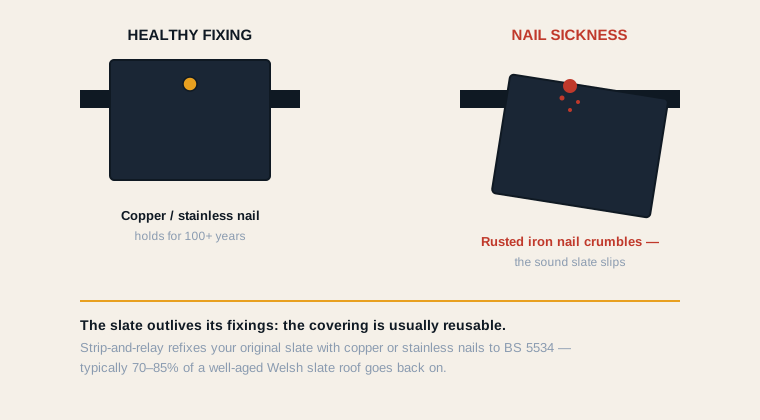
Nail sickness is the corrosion of the galvanised steel nail fixings used on 1960s–70s concrete tile roofs, leaving tiles retained by gravity rather than fixings. Signs: tiles that have slipped out of alignment, loose tiles that can be pushed by hand, visible rust staining below tiles. Affects the majority of unmodified 1960s–70s roofs in Ashford. Free assessment at call-out.
Yes. The house is habitable throughout a re-roof. There will be noise, scaffold on the building, and limited access to some external areas. The roof is not open to the weather for more than a few hours at a time during stripping — we work in sections and immediately install new underlay as we go.
10-year written workmanship guarantee on all re-roofing work. Tile manufacturer's guarantee additionally (typically 30–50 years depending on product). Lead guarantee: Code 4 lead has a design life of 25–40 years.
Planning a new roof? See exactly what it costs in our Ashford new roof cost guide, with real 2026 prices by property type. Not certain you need a full re-roof? A roof inspection will tell you whether repair or replacement is the right call.
Free survey and itemised quote. We'll tell you exactly what needs doing and why, with no obligation to proceed.
01233 877 146