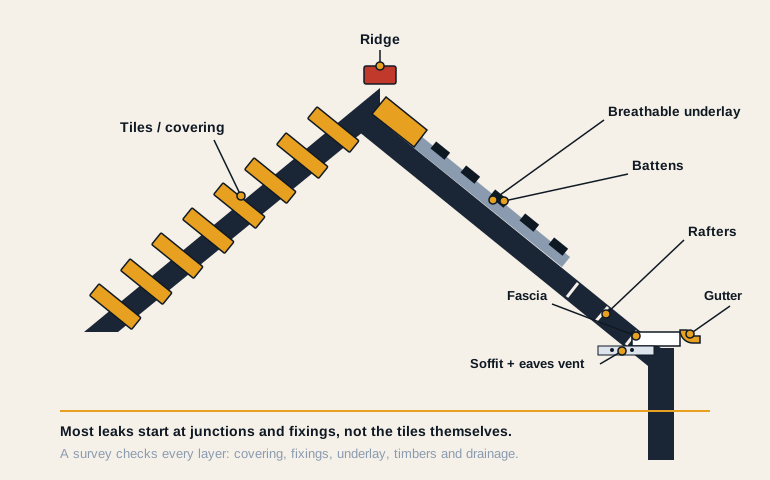
Roof repairs in Ashford cover slipped tiles, ridge repointing, lead flashing and nail sickness, typically costing £150-£900. We offer free call-outs, written quotes before work starts, and a workmanship guarantee up to 10 years on lead work. Call 01233 877 146 for same-day repair assessment.
From slipped concrete tiles on Bockhanger's post-war estates to lead flashing failures on Newtown's Victorian terraces — we diagnose and fix roof problems across Ashford fast, with honest pricing and no call-out fees. Free quotes: 01233 877 146.
Tell us the job in 30 seconds. No pushy sales, no call-out fee.
Most Ashford repair calls come down to a handful of failures you can often spot from the ground or a damp patch inside. Here is how to tell a genuine repair from a roof that has reached the end of the road.
When it is not the answer: If more than about a third of the covering has failed - widespread nail sickness on a 1960s estate roof, or perished underlay across whole slopes - repairing tile-by-tile is money wasted. Read the full guide.
Ashford's housing stock splits into two distinct repair populations. The post-war estates at Bockhanger and Stanhope, built in the 1960s with concrete interlocking tiles, are now in their late design life. Nail sickness — where original galvanised nails corrode and can no longer hold tiles in position — is widespread across these streets. A single loose tile quickly becomes ten once wind gets under adjacent courses.
The Victorian terraces in the Newtown area and around Church Road present different challenges. Original lead valleys and chimney flashings are the main failure points. East Kent's frost pocket conditions in the Stour valley accelerate the cracking of old lime-based bedding mortar, and once a flashing lifts, water finds its way in fast. Many of these properties sit in or near conservation areas, where matching original clay tile profiles and lead weights is a requirement.
Minor tile replacement: £150-£400. Valley repairs: £300-£700. Chimney flashing re-seal: £200-£500. Ridge repointing: £250-£600. Lead valley replacement: £400-£900. All prices include call-out and materials. Free written quotes before work begins.
📞 01233 877 146
Mon–Fri 8am–6pm · Sat 8am–2pm
Emergency: 24/7
We inspect from the roof and inside the loft, find the actual source (water tracks, so the stain is rarely under the leak), and show you photos.
A fixed price for the repair with materials, access and waste as separate lines - no call-out fee, no obligation.
Most repairs are booked within a few days; genuine emergencies with water coming in are prioritised same-day.
We refix or replace the failed tiles, flashing or valley, matching materials to your roof - reclaimed where the stock needs it.
We clear debris, magnet-sweep for stray nails, walk the finished repair with you and hand over the written guarantee.
| Job | Typical duration |
|---|---|
| Slipped or cracked tile refix | 1-2 hours |
| Lead flashing renewal (chimney or abutment) | Half a day |
| Rear valley rebuild | 1-2 days |
| Storm-damage make-safe | Same day, then permanent repair booked |
Wet or high-wind days pause tiling work - we build weather margin into every Ashford booking and apply temporary weatherproofing if rain stops play.
Most Ashford repairs run from roof ladders or a tower; scaffold is quoted only where the job needs safe standing time at height. Scaffold is specified for: chimney-side repairs, full valley rebuilds, or anything beyond a day at height - always itemised in your written quote, never a hidden extra, and we arrange it.
Ashford's Victorian terraces around Newtown and Church Road often have rear access only, so scaffold and skip placement need planning; the post-war estates at Bockhanger and Stanhope have driveways that usually take a skip without a permit. Pavement scaffold and skip permits go through Ashford Borough Council; allow a few working days on streets like the terraces around Newtown, Bank Street, the older lanes off Beaver Road where space is tight.
"Dozens of tiles loose on our Bockhanger property — classic nail sickness. The team stripped the affected area, replaced battens and re-tiled with matching concrete. Solid job at a fair price."
"Lead valley had failed on our Victorian terrace near Bank Street. They sourced the correct weight lead and matched the original profile exactly. Very pleased with the finish."
"Ridge tiles had lifted along most of the back section. They repointed and rebedded the whole ridge line on our Kennington semi in a single day. Clean job, fair quote."
Ashford's housing stock produces a predictable set of repair calls. The 1960s and 1970s concrete interlocking tile estates at Bockhanger, Stanhope and Singleton are the primary source of nail sickness repairs — the galvanised steel nail fixings in these properties have now corroded in a significant proportion of unmodified roofs, producing loose and sliding tiles that require systematic re-fixing or section re-tiling. On the Victorian terraces in Newtown and Willesborough, clay tile slippage on steep pitches and lead valley failure are the most common presenting problems.
Ridge mortar failure is the most widespread single repair call across all housing eras. The mortar haunching that beds the ridge tiles onto the apex of the roof is exposed to freeze-thaw cycling on every winter, and on most Ashford properties that have not had ridge work in the last 20 years the mortar is cracked or absent on at least some sections. Re-bedding and re-pointing ridge tiles is straightforward work that prevents the more expensive consequences of water ingress through an open ridge.
Flat roof repairs on rear extensions are the fourth significant repair category. The vast majority of Ashford's post-war and 1980s housing stock has at least one flat-roofed extension or outbuilding. Felt flat roofs from the 1990s and early 2000s are now at end of life, producing the blistered, cracked and leaking surfaces that generate the highest volume of non-emergency repair calls.
The 1960s and 1970s estates at Bockhanger, Stanhope, Singleton and Park Farm were built predominantly with concrete interlocking tiles on galvanised steel nail fixings. The design life of galvanised steel fixings in a pitched roof environment is approximately 40 years. These properties are now 50–65 years old. On properties where the original tiles and fixings have not been disturbed, a significant proportion of the nails are corroded, leaving tiles retained by gravity alone. Windspeeds that would not have moved a fully-nailed tile are now sufficient to displace several at once. The repair is systematic re-fixing of loose tiles or section re-tiling with new stainless fixings where the existing tiles are damaged.
The Victorian and Edwardian terraces in Ashford's Newtown area and along Norman Road carry clay plain tiles or clay peg tiles on steep pitches. These properties are 100–140 years old and many carry original tile stock. Original clay tiles in good condition are worth preserving — modern clay tiles are manufactured to an equivalent standard but new tiles need time to weather to match the patina of old stock. When individual tiles crack or break, sourcing closely matching clay is the priority. We hold stocks of reclaimed Kent clay tile for exactly this purpose.
Every roof repair job starts with a free call-out and inspection. We assess from ground level first, then use safe ladder or scaffold access to inspect the specific fault up close. We do not quote for work we have not seen. Once we have confirmed the extent of the repair needed, we provide a written quote before any work starts. The quote covers all materials, labour and any scaffold or access equipment required. There are no additional charges on the invoice.
On straightforward repairs — tile replacements, ridge repointing, lead flashing work — we typically complete the job on the same or next working day visit after quoting, unless materials need to be sourced. For section re-tiling or more extensive work, we confirm a start date and duration at the time of quoting. You will not be left waiting for weeks with an unconfirmed start date.
After completing any repair, we carry out a visual check of the surrounding area to confirm there are no adjacent tiles or details that are at immediate risk. We will tell you if we see anything that needs attention in the near term, without pressure to book further work on the spot.
Roof repairs where water is actively entering the building are treated as urgent. We prioritise these calls over routine maintenance work and aim to attend on the same day where call volume permits. If we cannot attend the same day, we will advise on temporary measures to limit the ingress until we can attend. Emergency 24/7 cover is available for situations where immediate attendance is required — call 01233 877 146.
All repair work carries our written workmanship guarantee. The guarantee period depends on the nature of the repair: minor tile work 2 years, lead flashing work 10 years, ridge repointing 5 years. Materials are warranted by the manufacturer independently. We use manufacturer-approved materials throughout. We do not use reclaimed materials on waterproofing details such as lead and underlay.
| Job | Typical range | Notes |
|---|---|---|
| Slipped / cracked tile refix | £150 - £250 | Per visit incl. access |
| Lead flashing renewal | £250 - £600 | Chimney or abutment |
| Ridge re-bedding (per metre) | £40 - £70 | Repointing loose ridge tiles |
| Valley repair / rebuild | £450 - £1,200 | Depends on length & lead |
| Storm-damage make-safe | £150 - £400 | Emergency temporary cover |
Worked example: a rear valley rebuild on a 1930s semi off Beaver Road, including new Code 4 lead, access tower and waste, runs around £680.
No deposit on repairs under £500 - you pay on completion once you are happy. Larger repairs are staged, with nothing due before materials are on site. VAT included in every quote.
Covering TN23, TN24, TN25 and surrounding postcodes.
Workmanship on the repaired section is covered for 10 years in writing; any replacement tiles or lead carry manufacturer warranties on top.
If a fault appears in covered work, we come back and put it right. No quibbling, no re-charge.
A repair is usually a few hours of ladder work and a small amount of tile debris - we sheet below the work area and clear everything before we leave. Most of this work is outside, so being home is optional — just sort access and any power we will need beforehand.
Repairs run year-round; temporary weatherproofing goes on the same day if rain interrupts. The Stour valley sits low and damp, a frost pocket that slows drying through autumn and winter, so we build a weather margin into every Ashford booking.
Because a repair is targeted, we are usually off your property the same day, leaving only the mended section changed and everything else untouched.Repairs in Ashford typically range from £150 for minor tile replacement to £900 for valley work. Nail sickness repairs on Bockhanger and Stanhope generally cost £300-700 depending on how many tiles have slipped. Free itemised quotes.
Nail sickness tile replacement on post-war Bockhanger and Stanhope estates, lead flashing repairs on Victorian terraces in the Newtown area, and blocked valley clearance caused by autumn leaf fall from the Willesborough tree canopy.
Most single-issue repairs — slipped tiles, a flashing re-seal, a single valley — are completed in half a day to a full day. More complex work on conservation area properties requiring material matching can take 2-3 days.
Yes. Free no-obligation inspections and quotes across Ashford. We can often diagnose issues from ground level before going on the roof. Call 01233 877 146 to arrange.
Isolated tile damage or flashing failure almost always points to repair. Systemic nail sickness across most of a roof, perished underlay, and multiple failures in different areas point toward replacement. We confirm the correct course of action at the free survey. We will not recommend replacement when repair is the right answer.
Yes. We hold stocks of reclaimed Kent clay tile and have access to specialist suppliers. Exact colour matching depends on the age and source of the original tiles, but we will show you samples before committing to a repair.
Like-for-like repairs using the same materials on the same elevation are permitted development in most cases. Conservation area properties and listed buildings have additional requirements — we advise on this at the survey stage.
Most repairs are completed in a single half-day to full-day visit. Larger section re-tiling or complex flashing work may take 2–3 days. We confirm the duration at the time of quoting.
Yes. Written workmanship guarantee on every job. 2 years for minor tile work, 5 years for ridge work, 10 years for lead flashing work. Provided in writing before we leave site.
Not sure what's wrong? A professional roof inspection in Ashford pinpoints the exact fault before you spend on repairs — and the fee is credited against the work. Want to know the likely cost first? See our Ashford roof repair cost guide. Storm damage? We handle storm repairs and insurance claims too.
Free inspection and itemised quote across Ashford. No call-out fees.
01233 877 146We cover Ashford and all surrounding Kent towns. See our location-specific repair pages below.