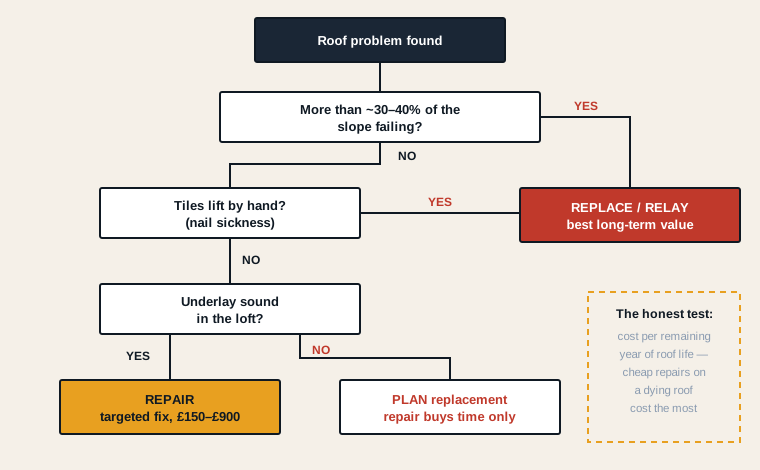
Repair if the covering is sound and the problem is localised - slipped tiles, a failed flashing, one worn valley. Replace when failure is systemic: widespread nail sickness, perished underlay, or repair costs approaching 30% of a re-roof. On Ashford's 1960s estates, spreading nail sickness usually tips the balance to replacement.
An honest decision framework from roofers who work Ashford's estates and terraces every week — no upsell, no scare tactics. Free assessment: 01233 877 146.
Tell us the job in 30 seconds. No pushy sales, no call-out fee.
📞 Call Now: 01233 877 146The honest answer turns on three things: how old the roof is, whether the failure is localised or systemic, and the cost of repair set against the remaining life a re-roof would buy. A sound roof with one failed valley is a repair every time. A roof where the underlay has perished and tiles are slipping across whole slopes is throwing money at repairs that only postpone the inevitable.
Here is the framework we use on every Ashford assessment, and we will tell you which side of it your roof falls on — including when replacement would be an oversell.
Ashford's housing splits into eras that each behave differently, and the repair-or-replace line sits in a different place for each. The 1960s-70s concrete interlocking tile estates at Bockhanger, Stanhope, Park Farm and Singleton are the town's clearest replacement candidates once nail sickness sets in. These roofs reach a tipping point where the original galvanised nails corrode across a whole slope at once — and past that point, refixing tiles one section at a time is a losing race against the next section failing. When we find systemic nail sickness on these estates, replacement with new stainless fixings, breathable membrane and battens is genuinely the cheaper long-run choice.
The Victorian and Edwardian terraces in Newtown and around Church Road are the opposite. These roofs, in Welsh slate or clay tile, were built to last a century, and the failures we see — a cracked lead valley, a slipped slate, failed flashing — are almost always localised and eminently repairable. Replacing a sound Victorian slate roof because of one failed valley would be an expensive mistake, and we will say so. Here the honest steer is nearly always repair, with reclaimed matching materials to keep the roof original.
The newer estates — Park Farm's later phases, Kingsnorth, the modern developments — sit in between. Their concrete tiles have decades of life left, so covering failures are usually repairs, but their flat-roofed extensions are a different clock: felt that is now 15-20 years old and at the end of its life, where replacement in GRP or EPDM is the sound call. The Stour valley's frost-pocket humidity accelerates the deterioration of pointing and flashings across all these eras, which is why a mid-life Ashford roof often needs targeted repair work a few years earlier than the same house would elsewhere.
📞 01233 877 146
Mon–Fri 8am–6pm · Sat 8am–2pm
Emergency: 24/7
When the cost of the repairs a roof needs approaches 30% of a full re-roof, replacement usually wins — because you are spending a third of the price to buy a fraction of the life. Below that, repair is almost always the sensible spend.
Divide each option by the years of life it buys. A £600 repair that buys 3 more years is £200/year. A £6,000 re-roof that buys 50 years is £120/year. On a failing roof, replacement is frequently the lower annual cost — the headline just looks bigger.
If the underlay has perished, refixing tiles does nothing for the layer that actually keeps water out. Once we see perished felt through the loft on an Ashford estate roof, further tile repairs are treating symptoms, not the cause.
A sound roof with one bad valley, a handful of slipped tiles, or a single failed flashing does not need replacing — and any roofer pushing a full re-roof for a localised fault is not acting in your interest. We fix what is broken and leave the rest.
Timescale is part of the decision, and the two routes are very different. A localised repair — a slipped-tile refix, a single flashing, a valley patch — is usually a half-day to a day, often completed on the first visit once quoted. A full re-roof on a standard Ashford semi runs five to eight working days depending on size, pitch and chimney count, with scaffold up for the duration. If your decision is being driven by an active leak, the sensible sequence is always the same: we make the roof safe and watertight the same day, then take the repair-or-replace decision without the pressure of water coming in. A roof that has been made safe buys you the time to choose the right long-term answer rather than the fastest one.
The Stour valley's autumn and winter damp adds a weather-margin caveat to both routes: tiling and re-roofing work pause in heavy rain or high wind, so we build realistic margins into any winter booking rather than promising dates the weather can't keep. This is worth weighing if your roof is marginal heading into winter — a planned replacement in the drier months is smoother than an emergency one in January.
| Option | Typical Ashford Cost | Life Bought |
|---|---|---|
| Localised repair (tiles, flashing) | £150 – £900 | Extends current roof |
| Section re-fix (nail sickness, per 10m2) | £400 – £800 | 3 – 8 years on that slope |
| Full re-roof, 3-bed semi (concrete) | £4,800 – £7,500 | 40 – 60 years |
| Full re-roof (clay / slate) | £6,500 – £16,000 | 80 – 100+ years |
| Flat roof replacement (extension) | £1,200 – £5,500 | 25 – 40+ years |
Worked example: a Bockhanger 1960s semi with tiles slipping across two slopes — repeated section re-fixes would run £1,600-£2,400 over a few years and still leave perished underlay, so a £5,800 re-roof at roughly £120/year is the better spend. Southern-England labour rates; free assessment for your exact figure.
Every repair and every re-roof we carry out comes with a written 10-year workmanship guarantee — covering the quality of our work, transferable if you sell. On a re-roof, the tiles, membrane and other materials carry their own manufacturer warranties on top. What no guarantee covers is sudden storm or impact damage — that is what buildings insurance is for. If a fault ever appears in work we have done, we come back and put it right.
RICS and BRE stock-condition guidance frames roof renewal as a whole-life-cost decision rather than a headline-price one — weighing the cost of continued repairs against the remaining serviceable life a replacement would restore.
Source: RICS / BRE stock-condition guidance
Not sure which way to go? We'll give you an honest assessment free — no call-out fee, no pressure either way.
📅 Book Free Assessment"Two firms quoted us a full re-roof. These lot checked the loft, said the underlay was fine and it was just a failed valley. Saved us thousands. Honest."
"They were straight that our Stanhope roof was past repair — nail sickness everywhere. Showed me the maths on re-roofing versus patching. Made sense, glad we did it."
"Asked for a re-roof quote; they talked me out of it. Said the roof had years left and just needed a few repairs. Who does that? Booked them for the repairs on the spot."
Repair if the failure is localised and the covering is sound. Replace when failure is systemic - widespread nail sickness, perished underlay, or repair costs nearing 30% of a re-roof.
When the repairs a roof needs cost around 30% or more of a full re-roof, replacement usually wins - you'd spend a third of the price for a fraction of the remaining life.
On Ashford's 1960s-70s estates that's usually nail sickness. A few slipped tiles is a repair; slipping across whole slopes means systemic failure and replacement is the better spend.
Almost always yes. Slate roofs last a century and their failures - a cracked valley, slipped slate, failed flashing - are localised. Replacing a sound slate roof is rarely justified.
It's visible from inside the loft - perished, torn or crumbling felt. Once underlay has gone, tile repairs don't restore the waterproof layer, so replacement is the honest answer.
Yes. If your roof has years of life left and only needs repairs, we'll say so - pushing a full re-roof for a localised fault isn't in your interest or ours long-term.
Often, on a failing roof. Cost per remaining year frequently favours replacement - a re-roof's bigger headline buys decades, where repeated repairs buy only a few years each.
Honest advice either way. No call-out fee, written assessment before any work.
01233 877 146Mon–Fri 8am–6pm · Sat 8am–2pm · Emergency 24/7