Chimney repointing in Ashford costs £150-£800+ per stack depending on scope, with flaunching, cowls and capping itemised separately. We use lime mortar on pre-1920 stacks to prevent spalling, and cement-compatible mortar on newer stacks. Free call-out and survey. Call 01233 877 146.
Open mortar joints let water into your chimney stack and down into the house. We repoint with the correct mortar for your property's age, re-flaunch the pot bedding, and fit cowls and caps to keep weather out. Free survey: 01233 877 146.
Tell us the job in 30 seconds. No pushy sales, no call-out fee.
Repointing renews the mortar joints on a chimney stack. Ashford's frost pockets and the exposed position of stacks make spalled, crumbling pointing one of our most common chimney calls.
When it is not the answer: If the stack is structurally unsound or leaning, repointing alone will not fix it - that needs a partial or full rebuild, and we will be honest about which you need. Read the full guide.
The mortar joints in a chimney stack are exposed to weather on all four sides and typically crack within 20-30 years. We rake out the failed joints to a proper depth, brush clean, and repoint with the correct mortar — sealing the stack against the water ingress that causes damp on chimney breast walls.
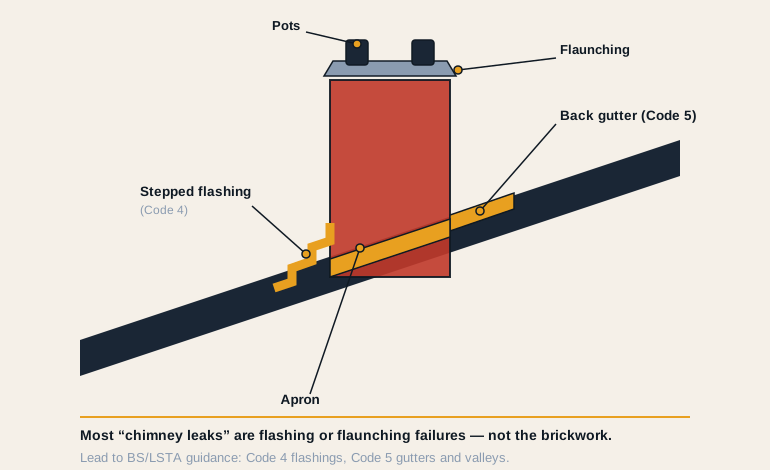
The flaunching is the mortar bed that holds the chimney pots on top of the stack. Cracked flaunching lets water into the stack and can loosen pots. We re-flaunch and re-bed pots as part of chimney work, and fit cowls to redundant flues to keep rain out.
Redundant chimneys need capping or cowling to stop rain entering a flue that no longer has the drying airflow of regular use. A cowl cap is an inexpensive intervention that prevents a slow, hidden source of internal damp.
We assess the mortar, brick condition and whether repointing is enough or a rebuild is needed.
Itemised with the mortar mix specified - lime for period stacks, matched to the original.
We scaffold to the stack for safe working - chimney work cannot be done safely from a ladder.
We rake out the failed mortar to a sound depth and repoint with the correct mix, matching colour and profile.
Final check, cleanup and a written guarantee.
| Job | Typical duration |
|---|---|
| Chimney repointing (typical stack) | 1-2 days |
| Repoint + flaunching renewal | 1-2 days |
| Scaffold erection | Adds part of a day |
| Partial rebuild + repoint | 2-4 days |
Mortar needs dry, frost-free conditions to cure - we schedule repointing around the weather, which matters in the Stour valley's cold, damp winters.
Repointing needs scaffold to the stack for safe standing time - it is standard for any chimney work and itemised in the quote. Scaffold is specified for: all chimney repointing - it is not a ladder job - always itemised in your written quote, never a hidden extra, and we arrange it.
Ashford's Victorian terraces around Newtown and Church Road often have rear access only, so scaffold and skip placement need planning; the post-war estates at Bockhanger and Stanhope have driveways that usually take a skip without a permit. Pavement scaffold and skip permits go through Ashford Borough Council; allow a few working days on streets like the terraces around Newtown, Bank Street, the older lanes off Beaver Road where space is tight.
The correct mortar depends entirely on the age of the stack, and Ashford has both extremes. The Victorian and Edwardian terraces in Newtown and around Church Road carry soft, permeable pre-1920 brick that must be repointed in lime mortar. Using hard modern cement on these stacks &mdash as too many general builders do &mdash transmits thermal stress into the soft brick face and causes it to spall and crumble over 20-30 years. We use NHL lime mortar on every pre-1920 Ashford stack, regardless of what was used before.
The 1960s-70s estate housing at Bockhanger, Stanhope and Park Farm is the opposite: these stacks were built with hard Portland cement mortar that is now 50-60 years old and beginning to open at the joints. Cement-compatible mortar is the correct repointing specification here, and the work is straightforward. These stacks are also where we most often find cracked flaunching, as the pot bedding has weathered through decades of frost cycling.
Stack exposure is the Ashford-specific weather factor. Chimneys catch the full force of the prevailing south-westerly weather coming up the Stour valley, and the windward face of a stack always deteriorates first. On the elevated properties toward Charing, on the North Downs escarpment, stacks face significantly higher wind and rain exposure than valley-floor houses — their repointing needs come round sooner, and the windward face is always the priority.
The mortar question genuinely matters, and it is the single most important thing an Ashford homeowner should understand about chimney repointing. The Victorian and Edwardian terraces in Newtown and around Church Road were built with soft, permeable brick and lime mortar, and they must be repointed in lime. Hard modern cement mortar, used on these soft old stacks by general builders who do not know better, is stronger than the brick around it — so when the two expand and contract at different rates through the seasons, the stress is forced into the brick face, which spalls, crumbles and blows over 20-30 years. The damage is slow, irreversible and expensive. We use NHL lime mortar on every pre-1920 Ashford stack regardless of what was there before, because it is the only specification that protects the historic brick rather than destroying it.
Stack exposure explains why some Ashford chimneys need attention far sooner than others, and it is worth knowing where your property sits. Chimneys catch the full, unobstructed force of the prevailing south-westerly weather driving up the Stour valley, and the windward face of any stack always deteriorates first — it takes the wind-driven rain that the sheltered faces are spared. On the elevated properties toward Charing, up on the North Downs escarpment, the wind and rain exposure is significantly higher than on the valley floor, and stacks there weather noticeably faster. When we assess an exposed Ashford stack we prioritise the windward face, because that is where the failure starts and where the water is getting in.
📞 01233 877 146
Mon–Fri 8am–6pm · Sat 8am–2pm
Emergency: 24/7
The pointing between the bricks of a chimney stack is exposed to weather on every face, with none of the protection the walls below get from the roof overhang. Over 20-30 years the mortar cracks, loses its grip and begins to fall out, and once the joints open, water gets into the core of the stack and tracks down to appear as damp on the chimney breast inside. Raking out the failed joints to a proper depth and repointing with the correct mortar seals the stack again — but the mortar choice is everything, and getting it wrong on Ashford's older stacks does lasting harm.
The flaunching is the sloping mortar bed on top of the stack that beds the pots and sheds water off the crown. It cracks with age and frost, and once it does, water sits in the cracks, freezes, and opens them further — eventually loosening the pots themselves. Re-flaunching renews this weathering surface and re-beds the pots securely. On Ashford's estate stacks, weathered flaunching is one of the commonest findings, the result of decades of the Stour valley's frost cycling working on the exposed crown.
Where the stack passes through the roof, the junction is weatherproofed with lead soakers, flashings and often a back gutter behind the stack. This leadwork fails independently of the brickwork — lead cracks with thermal movement, and old mortar-bedded flashings work loose. A proper chimney assessment checks the lead as well as the pointing, because a stack can be perfectly repointed and still leak at a failed flashing. We inspect and address both as part of chimney work.
| Job Type | Typical Cost |
|---|---|
| Repointing (single stack, lime) | £350 – £800 |
| Repointing (single stack, cement) | £250 – £650 |
| Flaunching / pot re-bedding | £150 – £400 |
| Cowl cap to redundant flue | £80 – £180 per flue |
| Chimney capping (redundant stack) | £200 – £500 |
Free call-out and inspection. Lime mortar for pre-1920 stacks. Written quote before work starts. Call 01233 877 146.
Building Regulations Approved Document J and NFRC guidance require chimney work to maintain the stack's weathertightness and structural stability, and specify that repointing mortar must be compatible with the original masonry — lime for soft historic brick.
Source: Approved Document J / NFRC chimney guidance
Free survey and honest written quote across Ashford and Kent — no call-out fee, no pressure.
Call 01233 877 146"Damp on our chimney breast in Newtown turned out to be open joints on the stack. They repointed it in lime — explained why cement would've wrecked the Victorian brick. Damp's gone."
"Cracked flaunching on our Stanhope semi had loosened a pot. Re-flaunched and re-bedded, fitted a cowl on the unused flue too. Solid work."
"Exposed stack up near Charing took a battering from the weather. They repointed the windward face properly and it's held through two winters now."
| Job | Typical range | Notes |
|---|---|---|
| Chimney repointing (typical stack) | £400 - £900 | Depends on stack size |
| Repoint + flaunching renewal | £500 - £1,100 | Top of stack too |
| Lime repointing (period stack) | £500 - £1,200 | Matched lime mortar |
| Scaffold to stack | Itemised | Included in quote |
| Partial rebuild + repoint | £900 - £2,000 | Where bricks have failed |
Worked example: lime repointing a weathered Victorian stack off Bank Street, including scaffold and matched mortar, runs around £950.
Staged on larger jobs, nothing before scaffold and materials on site. VAT included.
Covering TN23, TN24, TN25 and surrounding postcodes.
Repointing carries our written 10-year workmanship guarantee; correctly-mixed mortar in a repointed stack lasts decades.
If a fault appears in covered work, we come back and put it right. No quibbling, no re-charge.
Repointing means scaffold up and some noise cutting out old mortar - but it is contained to the stack and rooms below stay usable throughout. You do not need to stay home for external work — we just need power and access agreed in advance.
Repointing needs dry, frost-free weather to cure properly; we time it accordingly. Being down in the Stour valley, Ashford stays damp and frost-prone in winter and dries slowly, which is why we plan weather contingency into each job.
Raking out old joints with a grinder is the dustiest part, contained to the stack; we sheet below and clean the tiles and any rooflight afterwards.£350-£800 for a single stack in lime mortar, £250-£650 in cement. Flaunching is £150-£400 and cowl caps £80-£180 per flue.
Lime for pre-1920 stacks — the Victorian terraces in Newtown — because cement spalls soft historic brick. Cement-compatible mortar for the 1960s-70s estate stacks.
Damp on the chimney breast after rain, mortar fragments on the roof below, open joints visible from the ground, or white salt staining on the brick.
The mortar bed that holds the chimney pots on the stack. Cracked flaunching lets water in and loosens pots — we renew it and re-bed the pots.
Yes. A redundant stack weathers like any other but without drying airflow. We fit cowl caps and can cap the stack to stop water entering.
A single stack with scaffold is usually a full day. Fresh mortar is protected from rain for 24 hours to cure properly.
Stacks catch the full prevailing weather up the Stour valley. Elevated properties toward Charing face higher wind and rain, so the windward face fails first.
Broader chimney work? Repointing is one part of chimney care — for cracked pots, failed flashing or structural stack repairs, see our full chimney repairs in Ashford.
No call-out fee. Written quote before any work starts. NFRC registered and fully insured.
01233 877 146Mon–Fri 8am–6pm · Sat 8am–2pm · Emergency 24/7