Chimney repairs in Ashford cover repointing (£350-£800), lead flashing replacement (£500-£1,100) and pot renewal, using correct lime mortar on pre-1920 stacks to prevent spalling. Free call-out and inspection, with a written quote provided before any work starts. Call 01233 877 146 to book a chimney inspection across Ashford and Kent.
Repointing, lead flashing, pot replacements and full chimney rebuilds across Ashford. The Victorian and Edwardian terraces in the Newtown area and around Church Road and Bank Street generate the majority of our chimney repair work — frost-damaged lime pointing and failed original lead flashings. Free survey: 01233 877 146.
Tell us the job in 30 seconds. No pushy sales, no call-out fee.
Ashford's Victorian terraces around Church Road and Bank Street generate most of our chimney work - frost-damaged lime pointing and failed original lead are the usual culprits.
When it is not the answer: If the stack is sound and only the flashing has failed, a leadwork repair fixes the leak - you do not need a full rebuild, and a rebuild for a flashing fault is oversell. Read the full guide.
The Victorian and Edwardian stock concentrated in Ashford's Newtown area — particularly the terraced streets running off Church Road and Bank Street — carry some of the town's most maintenance-intensive chimneys. Original lime pointing, first laid over a century ago, has been subjected to every frost winter has brought to the Stour valley. The freeze-thaw cycle cracks old pointing efficiently, and once cracking starts, water gets in and the process accelerates.
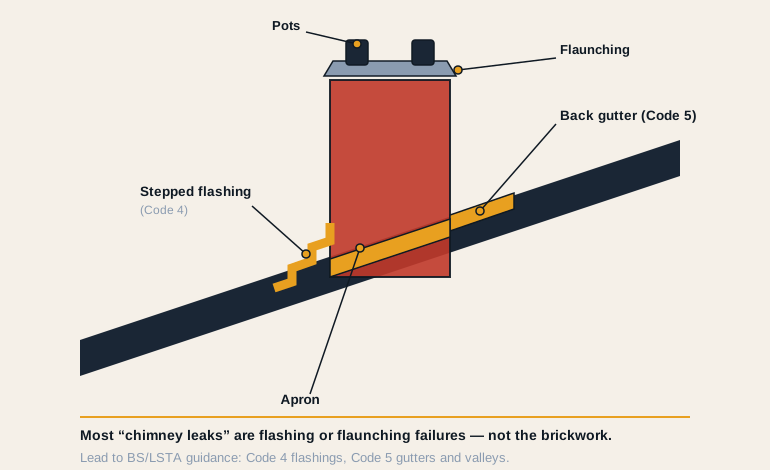
Lead flashings on these properties are another common failure. Original lead has hardened and cracked over time. When the flashing lifts at the back gutter or step junction, rainwater tracks down the chimney stack and into the ceiling below — often invisible until there's secondary plaster damage inside.
Lead flashing re-seal: £150-£350. Chimney repointing (single stack): £200-£500. Chimney pot replacement: £180-£400. Stack repointing and cap: £300-£700. Full chimney rebuild: £800-£2,000+. All prices include access and materials, free survey before commitment.
📞 01233 877 146
Mon–Fri 8am–6pm · Sat 8am–2pm
We inspect the stack, pointing, flashing and pots from the roof and identify the actual source of any damp.
Itemised for repointing, flashing, pot work or rebuild, with scaffold priced separately.
Chimney work needs safe standing time, so we scaffold to the stack - arranged and licensed by us.
We repoint, renew lead flashing, replace pots or rebuild the stack as needed, matching brick and mortar.
Final check, cleanup and a written guarantee on the work.
| Job | Typical duration |
|---|---|
| Lead flashing renewal | Half a day - 1 day |
| Chimney repointing | 1-2 days |
| Pot replacement | Half a day |
| Full stack rebuild | 2-4 days |
Mortar and repointing need dry, frost-free conditions to cure, so we schedule chimney work around the weather - the Stour valley's frost pockets make winter timing matter.
Chimney work almost always needs scaffold to the stack for safe working - a chimney cannot be repaired safely from a ladder. Scaffold is specified for: all chimney work above flashing-only repairs - it is standard and itemised - always itemised in your written quote, never a hidden extra, and we arrange it.
Ashford's Victorian terraces around Newtown and Church Road often have rear access only, so scaffold and skip placement need planning; the post-war estates at Bockhanger and Stanhope have driveways that usually take a skip without a permit. Pavement scaffold and skip permits go through Ashford Borough Council; allow a few working days on streets like the terraces around Newtown, Bank Street, the older lanes off Beaver Road where space is tight.
"Chimney stack on our Victorian terrace off Church Road needed full repointing. They matched the lime mortar correctly for the conservation area and left it looking as it should. Proper job."
"Lead flashing had lifted at the back gutter of our Bank Street terrace. Water was tracking all the way to the first floor ceiling. They fixed it in a morning and the issue was resolved immediately."
"Old pot had blown off our Kennington semi in a storm. They replaced the pot, repointed the flaunching and re-sealed the lead while they were there. Everything for a sensible combined price."
Chimney stacks on Ashford's housing stock are among the most neglected maintenance items on any property. Out of sight on the roof slope and above the ridge, chimney deterioration is invisible until it produces a symptom — a damp patch on a chimney breast wall, a missing pot visible from the street, or a survey report identifying pointing failure. By the time these symptoms appear, the deterioration has usually been progressing for several years.
Chimney repointing is the single most common chimney repair call we attend across Ashford. The mortar joints between the bricks in a chimney stack are exposed to the full range of weather — rain, frost, wind, UV — from all four sides simultaneously. Standard Portland cement mortar begins to crack and open within 20–30 years on most Ashford stacks. Open joints allow water entry into the stack body, which accelerates brick face spalling and leads to damp on interior chimney breast surfaces. Repointing with the correct mortar specification — lime-based for pre-1920 stacks, cement-based for modern stacks — seals the joints and restores the stack to weathertight condition.
The lead flashing at the junction between the chimney stack and the tile or slate covering is the second most common chimney repair. Lead flashings on Ashford properties typically last 25–40 years for Code 4 lead in a standard inland position. Failure modes are: cracking from thermal cycling at the fold line, lifting at the soaker tucked under the tiles, and open joints in the mortar that holds the lead step flashing into the brick coursing. Failed chimney lead is one of the most reliable causes of chimney breast damp — the water ingress at this junction runs down inside the stack, tracking internally rather than producing a visible external stain.
Chimney pots on Ashford's Victorian properties are fired clay or salt-glazed ceramic. Original pots can last 150 years without failure if left undisturbed, but frost cycling cracks pots that have absorbed water through their base or the haunch mortar. A cracked pot allows rain entry into the flue. Redundant flues — sealed at the fireback after gas conversion — have no drying airflow to manage moisture that enters at the top. We fit cowl caps to redundant flues as a matter of course when attending chimney repairs, preventing future water entry without the cost of full pot replacement.
The correct mortar specification for chimney repointing depends on the age of the stack. Pre-1920 brick — covering all Victorian and Edwardian properties in Ashford's Newtown area, Willesborough and the older town centre streets — is soft and permeable. It was built to absorb and release moisture, with lime mortar as the flexible medium that accommodates thermal movement without cracking.
Modern Portland cement mortar is harder than the brick it is used with. On soft Victorian brick, cement mortar does not crack and flex with thermal movement — the brick face does. The visual symptom of incorrect cement repointing on period brick is spalling: the brick face breaks away in fragments, following the crack lines created by the rigid mortar joints. On Ashford's Victorian terraces, we regularly see chimney stacks where well-intentioned cement repointing has caused more damage over 30 years than the original deteriorated lime mortar would have.
Chimney rebuilding is justified when more than 25–30% of the brick courses have failed, when the stack is leaning visibly out of plumb, or when the internal flue lining has collapsed. Rebuilding is also the correct approach where the existing stack has been incorrectly repointed with cement so many times that the facing brick is badly spalled and the stack has lost its original profile. In most other cases — open joints, failed lead flashings, isolated brick failure — repair is the appropriate and more cost-effective approach. We give a clear recommendation at the survey with justification for the course of action proposed.
| Job | Typical range | Notes |
|---|---|---|
| Lead flashing renewal | £250 - £600 | Around the stack base |
| Chimney repointing | £400 - £900 | Depends on stack size |
| Chimney pot replacement | £150 - £400 | Per pot, incl. flaunching |
| Re-render / cap | £300 - £700 | Weatherproofing the stack |
| Full stack rebuild | £900 - £2,500 | From the roofline up |
Worked example: repointing and new Code 4 lead flashing on a Victorian stack off Church Road, including scaffold to the chimney, typically runs £850-£1,100.
Staged on larger rebuilds, nothing due before materials and scaffold are on site. Smaller flashing repairs paid on completion. VAT included.
Covering TN23, TN24, TN25 and surrounding postcodes.
Chimney repairs and rebuilds carry our written 10-year workmanship guarantee; new lead, pots and materials carry their own manufacturer terms on top.
If a fault appears in covered work, we come back and put it right. No quibbling, no re-charge.
Chimney work means scaffold up for the job and some noise from cutting out old mortar - but it is contained to one corner of the roof and rooms below stay usable. Most of this work is outside, so being home is optional — just sort access and any power we will need beforehand.
Repointing and rebuilds need dry, frost-free conditions; we time the work accordingly. The Stour valley sits low and damp, a frost pocket that slows drying through autumn and winter, so we build a weather margin into every Ashford booking.
Cutting out old mortar creates fine grey dust that settles on that side of the roof; we damp it down and brush the tiles and any conservatory roof below clean afterwards.Chimney repointing on a Victorian terrace in Ashford's Newtown area costs £200-£500. Lead flashing re-seal runs £150-£350. Full chimney stack rebuilds on neglected Church Road properties cost £800-£2,000+. Free inspection and quote before commitment.
The Victorian terraces in Newtown and around Church Road use lime-based mortar in the original pointing. Ashford's frost pocket conditions in the Stour valley accelerate deterioration — water infiltrates cracks, freezes and opens them further each winter. After 100+ years, most of this pointing is well beyond its service life.
For most flashing and repointing work we use MEWP access equipment rather than full scaffold, which keeps costs down. Full rebuilds or higher stacks typically need scaffold. We specify the right access method at the survey stage.
Yes. For properties within Ashford's conservation areas we use matching lime mortar mixes and appropriate lead weights. We advise on permitted development rules and planning consent requirements before any work begins.
Signs: damp patches on chimney breast walls (particularly after rain), mortar fragments on the roof slope below the stack, visible open or missing joints from ground level, white salt staining on the brick face. Annual visual inspection from a stable position is advisable on any property with original chimney stacks.
Lime-based (NHL) mortar for all pre-1920 stacks. Portland cement for post-1920 stacks. We confirm the correct specification at the survey. Using cement on Victorian brick causes spalling over time — we will not do this regardless of cost pressure.
Yes. Redundant stacks see the same weather exposure as active ones but without the drying benefit of flue airflow. Lead flashing failure on a redundant stack produces damp in the same way as on an active one. We recommend fitting cowl caps to seal redundant flue tops and inspecting the pointing every 5 years.
A single-stack repoint with scaffold typically takes a full day. The mortar needs to cure before being exposed to rain — we plan work around the weather forecast and will not leave fresh lime mortar exposed to rain within 24 hours of application.
For partial stack rebuilds on period properties, we source closely matching reclaimed brick from Ashford and Kent area demolition sources. Exact matching depends on availability. We show samples before committing to rebuild work on any visible chimney.
Is it the pointing? Cracked, open mortar joints on the stack need chimney repointing in Ashford — repointing, flaunching, cowls and capping. We assess both the brickwork and the lead as part of any chimney job.
Free inspection and written quote. No obligation. We'll tell you exactly what needs doing before you commit.
01233 877 146We cover chimney repairs across Ashford and all of Kent.