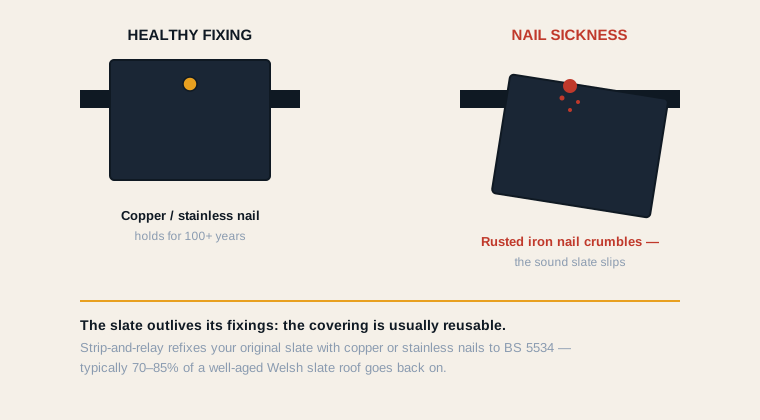
Nail sickness is the corrosion of galvanised steel nail fixings on 1960s-70s concrete tile roofs, leaving tiles held by gravity rather than fixings. It affects most unmodified properties on Ashford's Bockhanger, Stanhope and Park Farm estates. When 30%+ of tiles move under light pressure, re-roofing is more cost-effective than repair.
If you live on a housing estate built in the 1960s, 1970s or 1980s — Bockhanger, Stanhope, Kingsnorth or Willesborough in Ashford, Park Wood or Shepway in Maidstone, Cheriton in Folkestone — there is a significant probability that your roof has nail sickness, or will develop it within the next few years. It is by far the most common roofing problem we diagnose across east Kent.
Understanding what it is and how to spot it early can save you from a significantly larger repair bill, or an emergency call-out when a tile ends up in your garden after a storm.
Concrete interlocking roof tiles — the dominant tile type on British housing estates built between 1950 and 1990 — are fixed to the roof structure with galvanised steel nails. Galvanising (a zinc coating) protects the steel from rust for a period determined by the coating thickness and the environment. In most residential applications, that period runs between 25 and 40 years.
When the galvanising fails, the steel nail beneath begins to corrode. As it rusts, the nail expands, which can actually push the tile upwards slightly — loosening it. Eventually the nail corrodes through entirely, at which point the tile is held in place by gravity and friction alone. On a roof with a reasonable pitch, a loose tile can sit undisturbed for years. On a windy night, or under the weight of a person walking on the roof, it slides.
The term nail sickness describes this systemic failure of the original fixing nails across a roof. It is called systemic because all the nails were installed at the same time, in the same conditions, with the same materials — which means they tend to fail across the whole roof within a relatively short window, not one at a time over decades.
If your property was built between 1960 and 1990, get a free nail sickness inspection.
Book Free InspectionYou don't need to get on the roof to spot the warning signs. From ground level, with binoculars if you have them, look for:
The galvanised steel nails used on 1960s-70s concrete tile roofs have a design life of approximately 40 years — meaning the majority of unmodified roofs of this era are now past the point of reliable fixing.
Source: NFRC technical guidance on tile fixing
The challenge with nail sickness is that from the ground you typically see the tiles that have already moved. The tiles that are about to move — held by a corroded nail that has not yet failed completely — are invisible until they come down. A proper diagnosis requires getting on the roof surface and physically checking tile fixings across a sample of the roof area.
This is where some roofers and homeowners part ways. The appeal of repair is obvious: it costs less today. The reality of nail sickness repair is less appealing when you examine it closely.
When we re-nail or clip a tile that has slipped, we are fixing that specific tile. The tiles on either side, the course above, the course below — all have the same age nails in the same condition. They are not fixed by the repair. The roof will continue to shed tiles as the remaining nails corrode through, usually at an accelerating rate as the roof ages beyond its design life.
Repair makes sense when nail sickness is genuinely localised — perhaps a south-facing elevation has had more UV and thermal cycling than a north-facing one, and the failure is concentrated in one area while the rest of the roof remains sound. This is real but less common than homeowners hope.
Replacement makes more economic sense when nail sickness is present across more than two or three roof elevations, when the tiles themselves are showing surface degradation (spalling, algae penetration into the surface), or when the roof is over 40 years old. At this age, the underlay beneath the tiles — which provides secondary waterproofing when tiles are displaced — has also reached end of life. Re-nailing tiles on top of a perished underlay is fixing one problem while leaving a larger one untouched.
Spot tile replacement and re-nailing: £150–£500 depending on the number of affected tiles and access requirements.
Partial section replacement (one elevation, new battens and tiles): £800–£2,500 depending on the size of the section.
Full re-roof on a 3-bed semi (concrete interlocking tile): £4,500–£7,000 including scaffold, full batten and underlay replacement, new tile system and ridge.
We will always tell you clearly which of these is appropriate for your roof at the survey stage. We don't push re-roofs when repair is genuinely the right call, and we don't recommend patchwork when the roof needs replacing. Both approaches cost us customers in different ways.
Worried about nail sickness on your property? Free inspection across Ashford, Maidstone, Folkestone and Kent.
Book Free InspectionAny concrete interlocking tile roof from the 1960s–1980s is in the risk window. The estates we see most frequently across our coverage area include:
If your property is on a similar estate in another Kent town, the same timeline applies. The concrete interlocking tile was used almost universally on British spec housing from this era, and the galvanised nail was the standard fixing across the industry.
Every nail sickness roof tiles job starts with a free inspection and written quote before any work begins. We do not start work until you have confirmed the written quote. Our standard rates apply across Ashford and the surrounding Kent area.
We cover all Ashford postcodes and the surrounding towns: Folkestone, Canterbury, Maidstone, Tenterden, Hythe and the villages across the Weald. Emergency cover is available 24 hours a day on 01233 877 146.
No call-out fee across our full service area. Written quote before work starts. For nail sickness roof tiles work the quote is provided on the same visit as the inspection in most cases. You pay only for work carried out.
All re-roofing work and major repairs carry our written 10-year workmanship guarantee. Lead flashing work is guaranteed for 10 years. Minor tile repairs carry a 2-year guarantee. The guarantee is provided in writing at completion and transfers to a new owner if the property is sold.
We are registered with the National Federation of Roofing Contractors. Verify our registration at nfrc.co.uk. We carry 5m public liability insurance on every nail sickness roof tiles job. Insurance certificate available on request before work starts.
Ashford's housing stock spans five decades of construction: Victorian and Edwardian terraces in Newtown and the older town streets, 1930s semis in Kennington and Willesborough, post-war and 1960s estates at Bockhanger, Stanhope and Park Farm, and more recent development across the southern suburbs.
Each era presents different characteristics. Victorian clay tile on period properties requires matching reclaimed material and lime mortar at any repointing work. 1960s concrete interlocking tile on the estates is now 50-65 years old with corroded nail fixings on most unmodified properties. Understanding which housing era a property belongs to is the starting point for any assessment.
These estates are Ashford's highest-volume source of roofing work. The 1960s-70s concrete interlocking tile stock is now 50-65 years old. Nail sickness is present on the majority of unmodified properties. If you live in one of these areas and have not had roofing work in the last 15 years, a free assessment is worthwhile.
The Victorian terraces in Ashford's Newtown area and the older streets around the town centre require period-appropriate specification: reclaimed or reproduction clay tile, lime mortar at chimney repointing, and conservation-aware approach to any work on visible elevations.
Free survey and advice across Ashford and Kent. Call 01233 877 146.
Call 01233 877 146For context on how roofing costs compare across the range of work we carry out, here are realistic price ranges for the most common jobs across the Ashford area. All prices include labour and materials. VAT is not applicable on most domestic residential roofing work.
| Job Type | Typical Cost |
|---|---|
| Single tile replacement | £150 – £300 |
| Ridge repointing (per 4m) | £200 – £400 |
| Lead chimney flashing replacement | £500 – £1,100 |
| Full re-roof (3-bed semi, concrete tile) | £4,800 – £7,500 |
| Flat roof replacement (GRP, up to 20m2) | £900 – £1,800 |
| Full gutter clear (semi-detached) | £80 – £160 |
| Fascia and soffit replacement (semi) | £800 – £1,800 |
| Roof condition survey | £120 – £200 |
Free written quotes on all work. No call-out fee. Call 01233 877 146 to book.
We are a family-run roofing business based in Ashford, covering the town and the surrounding Kent area. We have been working on roofs in this area since 2003. Every job is carried out by our own employed team — we do not subcontract labour. The people who quote are the people who work.
We are registered with the National Federation of Roofing Contractors (NFRC). Our registration can be verified at nfrc.co.uk. We carry £5m public liability insurance on every job. Our insurance certificate is available on request before any work starts. All re-roofing work carries a written 10-year workmanship guarantee. Lead flashing work is guaranteed for 10 years. The guarantee is transferable to a new owner if the property is sold.
We cover Ashford and a broad area of the surrounding Kent countryside: Folkestone, Hythe, Canterbury, Maidstone, Tenterden, and the villages across the Weald and Romney Marsh. Emergency cover is available 24 hours a day, 7 days a week. Call 01233 877 146 for any roofing emergency. For non-urgent work, we aim to survey within 5-7 working days and have the quote in writing within 48 hours of the survey.
We do not charge for call-outs or surveys. Every job gets a written quote before a single tile is moved. The quoted price is the price on the invoice unless we identify and agree additional scope with you during the work. For re-roofing projects where deck condition is unknown before stripping, we include a clear provisional allowance for batten replacement rather than presenting you with a surprise on invoice.
Last reviewed: July 2026
Nail sickness is the corrosion of the galvanised steel nails fixing tiles to the battens on 1960s-70s concrete tile roofs, leaving tiles held by gravity and prone to slipping in wind.
From close access, tiles affected by nail sickness shift under light pressure. When 30% or more of a slope moves, the fixing system has failed and re-roofing is the correct response.
The 1960s-70s concrete tile estates at Bockhanger, Stanhope, Singleton and Park Farm produce the most nail sickness calls, as their fixings are now past design life.
Isolated nail failure can be repaired by re-fixing with stainless nails. Systemic nail sickness across most of a slope is more cost-effectively addressed by full re-roofing.