Leadwork in Ashford covers chimney flashings (£500-£1,100), valley linings and abutment details in Code 4 or Code 5 lead, correctly bay-sized to prevent the fatigue cracking that causes premature failure. All lead work carries a written 10-year guarantee. Free inspection. Call 01233 877 146 for leadwork across Ashford and Kent.
Specialist lead flashing, valley lining and abutment work across Ashford and Kent. Correct lead code, proper fixings, BS 6915 standard. Not a patch — a permanent solution. Call 01233 877 146 for a free assessment.
Tell us the job in 30 seconds. No pushy sales, no call-out fee.
Lead is the traditional weatherproofing at every roof junction - valleys, flashings, soakers and bay tops. On Ashford's Victorian terraces the original lead is now well past its life and a common leak source.
When it is not the answer: If the lead is sound and it is a tile or mortar fault causing the leak, that is the cheaper fix - we diagnose the actual source before recommending leadwork. Read the full guide.
Lead flashing is the primary weatherproofing junction between a roof surface and any vertical element: chimneys, dormer walls, abutments to party walls or extensions, and valley linings. When it fails, water tracks into the roof structure and ceiling below. When it is patched rather than replaced, it fails again. Most Ashford lead flashing failures we are called to have a repair history — a trail of previous patches that worked briefly and then failed from the same underlying cause.
The underlying cause is almost always one of three things: undersized lead (wrong code for the application), inadequate lap at joints allowing water ingress under thermal movement, or incorrect fixing allowing the lead to creep and crack. A patch fixes the visible leak point but not the cause. The correct response to failing lead that has been patched before is full replacement to current standard.
We work to BS 6915, the British Standard for lead sheet in building. This specifies minimum lead codes for each application, maximum bay lengths to prevent thermal creep cracking, correct lap dimensions at joints and appropriate fixing methods. Victorian terraces in Newtown and the older streets around the town centre were originally flashed with lead that met the standards of their era — which are less demanding than current specification. A replacement job done to BS 6915 on one of these properties will outlast the original leadwork by decades if the original building is maintained.
We inspect all lead details before quoting and give you an honest view of what needs replacing vs patching.
📞 01233 877 146
| Job Type | Typical Cost |
|---|---|
| Chimney flashing replacement | £400 – £800 |
| Valley lead replacement (per linear metre) | £80 – £150/m |
| Step flashing (dormer or abutment) | £300 – £700 |
| Soakers (per 10) | £100 – £200 |
| Parapet capping lead | £150 – £400 per section |
We identify every failed lead detail and the correct code of lead for each - valleys and flashings differ.
Itemised by detail, with the lead code and patination treatment specified.
We hand-dress new milled lead to the correct code, welt and clip it, and patination-treat it to prevent staining.
Final inspection and a written guarantee on the leadwork.
| Job | Typical duration |
|---|---|
| Single flashing or soaker set | Half a day |
| Valley re-lead | 1-2 days |
| Bay or porch top | Half a day - 1 day |
| Full re-lead of multiple details | 2-3 days |
Leadwork runs year-round; only high wind at height causes us to reschedule.
Leadwork at valleys and low abutments can run from towers; chimney and higher flashings need scaffold for safe standing time. Scaffold is specified for: chimney flashings, higher abutments, or valleys that need a full working platform - always itemised in your written quote, never a hidden extra, and we arrange it.
Ashford's Victorian terraces around Newtown and Church Road often have rear access only, so scaffold and skip placement need planning; the post-war estates at Bockhanger and Stanhope have driveways that usually take a skip without a permit. Pavement scaffold and skip permits go through Ashford Borough Council; allow a few working days on streets like the terraces around Newtown, Bank Street, the older lanes off Beaver Road where space is tight.
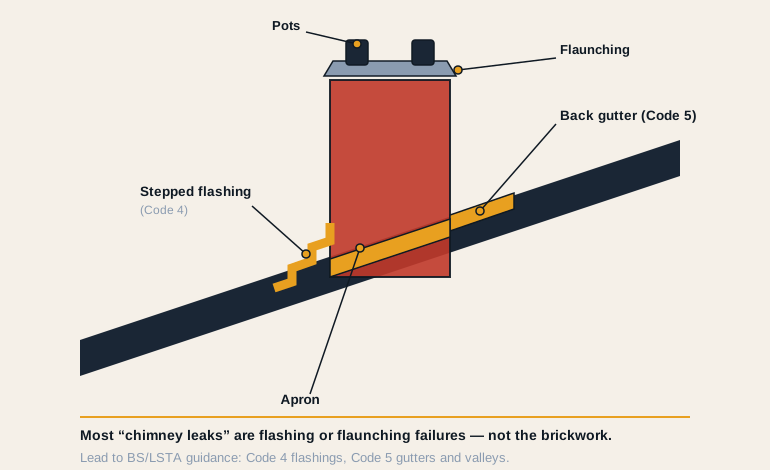
Front apron, back gutter, stepped side flashings and soakers. Full replacement in correct code lead with proper fixing and pointing. The most common leadwork job in Ashford.
Lead valley linings in period properties and conservation areas. Replacement in correct code for the pitch and valley width. Soakers cut and fitted as required.
Where a roof meets a vertical wall — dormer sides, extension junctions, party wall interfaces. Step and cover flashing correctly formed and fixed.
Lead dressed over parapet walls on flat roofs, bay windows and period property parapets. Correct drip edge and fixing to prevent wind uplift.
Individual lead soakers interlaced with tile courses at junctions. Correctly sized and lapped for the tile gauge and pitch. Cut on site to exact dimensions.
Open lead valleys in conservation areas and period properties where traditional detailing is required. Correctly sized for the catchment area and pitch drainage.
"Lead valley replacement on our 1890s terrace. They used the right lead code for the pitch, cut proper soakers and re-seated the surrounding tiles. Previous patches had never held. This has been completely dry for 18 months."
"Chimney flashing replacement on our 1930s semi. The original lead was completely corroded at the back of the stack. Full replacement run, correct fixings, pointed over correctly. Solid job."
"Step flashings on a period cottage dormer that had been leaking for years. They stripped the old work back completely and re-flashed to current standards. No issues since."
Lead sheet for roofing is classified by code, which corresponds to its weight per square metre and, therefore, its thickness. The higher the code, the thicker and heavier the lead. For most domestic roofing applications, Code 4 or Code 5 is the appropriate specification.
Code 4 lead (1.8mm thick, 20kg/m2) is the standard specification for chimney flashings, valley linings, parapet gutters and abutment flashings on most Ashford domestic properties. It has a design life of 25–35 years in a standard inland position. Code 4 is the specification mandated by BS EN 12588 for most domestic pitched roof applications.
Code 5 lead (2.24mm thick, 25kg/m2) is specified in situations where additional service life or resistance to physical damage is required: flat roof coverings, parapet capping, large area valley linings on steeply pitched roofs, and any application within the marine corrosion zone. For Ashford properties, Code 5 is not generally required for standard chimney and valley work. We specify Code 5 for Folkestone and Hythe seafront properties where salt air reduces Code 4 service life.
Lead appears in multiple locations on a typical Ashford property: the step and soaker flashings at chimney stacks (the junctions between the chimney and the tile slope); valley linings (the channels at the junction of two roof slopes); abutment flashings where a roof slope meets a wall; parapet capping on properties with parapet walls; and occasionally as a flat roof covering on small areas such as bay roof tops. Each of these locations has specific code and detail requirements. The valley lining on a long, steep pitch, for example, requires Code 5 where the Code 4 valley lining on a shorter, shallower pitch would be adequate.
Lead expands and contracts with temperature change at a rate approximately five times that of the brickwork and roof timbers it is fixed to. All lead flashings must be installed with correctly sized bays (typically no more than 1.5m in length for Code 4) with roll joints between bays that accommodate this thermal movement. Lead installed in oversized bays without roll joints develops fatigue cracks at the fixed points within 10–15 years, regardless of the lead code. The fatigue cracking of incorrectly installed lead is one of the most common causes of premature lead failure we see on Ashford properties.
| Job | Typical range | Notes |
|---|---|---|
| Single lead flashing | £200 - £500 | Per detail |
| Soaker set (per abutment) | £250 - £600 | Stepped abutment |
| Valley re-lead (per metre) | £90 - £160 | Code 4/5 milled lead |
| Bay / porch top | £350 - £800 | Depends on size |
| Full re-lead (multiple details) | £900 - £2,500 | Whole-roof leadwork |
Worked example: re-leading a cracked valley on a Newtown Victorian terrace in Code 5 milled lead, hand-dressed and patination-treated, runs around £520.
Paid on completion for single details; staged on full re-leads. VAT included.
Covering TN23, TN24, TN25 and surrounding postcodes.
Our leadwork carries a written 10-year workmanship guarantee; correctly-dressed milled lead itself lasts decades beyond that.
If a fault appears in covered work, we come back and put it right. No quibbling, no re-charge.
Leadwork is precise, quiet and localised to one roof junction - minimal mess and no need to be home for external work. For exterior jobs there is no need to be in; we only need agreed access and, for some jobs, an outdoor power point.
Lead can be worked in most weather; we avoid only high wind at height. The Stour valley sits low and damp, a frost pocket that slows drying through autumn and winter, so we build a weather margin into every Ashford booking.
Lead is dressed by hand with wooden tools, so it is near-silent work; there are no power tools, no dust and nothing to protect indoors.A standard chimney lead flashing replacement on an Ashford property typically costs £400-£800. Valley leadwork runs £500-£1,200 depending on the length and complexity of the run. Step flashing on a dormer or extension junction: £300-£700. Free written quotes before any work starts.
We specify Code 4 lead as the standard for most Ashford domestic applications including chimney flashings, valley linings and abutment details. Code 5 is used on exposed positions and on seafront properties in Folkestone and Hythe. Code 3 for soakers and small details. We confirm the specification at the survey stage.
Properly installed lead flashing with correct code, adequate lap and appropriate fixings should last 50-80 years. The reason most Ashford lead flashings fail well before this is incorrect original installation: undersized lead, inadequate lap at joints, clips omitted, or mortar pointing used instead of correct lead-to-brick fixing. Our replacement lead is installed to current BS 6915 standards.
Patched lead that has failed repeatedly is telling you the original lead is at end of life or was incorrectly installed. A third patch will fail for the same reason the previous two did. Full replacement is the correct response. We replace the full run rather than adding another patch.
Yes. Lead valley replacement on Victorian terraces in Newtown and the surrounding streets is one of our most regular jobs. We specify the correct lead weight for the pitch angle and valley width, cut correct soakers where required and ensure the tiling on either side is re-seated correctly.
Yes. Lead is used for parapet cappings, flat roof abutments and drainage details on both pitched and flat roofs. We carry out all lead flat roof work to the same specification standards as pitched roof leadwork.
The most common cause is fatigue cracking at the fold line — the crack is in the internal face of the fold, invisible from above. The second most common is the mortar chase lifting from the brick course, allowing water to track between the lead and the wall. Close inspection from safe access is required to identify the actual failure mode.
Yes. Lead is the correct material for all historic building flashings and the most planning-appropriate specification for conservation area properties. We advise on the correct lead detail for each property type and can document our specification in writing for planning records.
Isolated cracks and pinhole failures in otherwise sound lead can be repaired by burning (welding) or by lead-compatible sealant. Widespread fatigue cracking, corroded lead or lead that has been repaired multiple times is at end of life and requires replacement. We confirm the correct approach at the free inspection.
Free assessment across Ashford, Folkestone, Canterbury and all of Kent. No call-out fees.
01233 877 146Covering leadwork across Ashford and all of Kent.
We cover every Ashford neighbourhood. See area-specific pages below.